Showing posts with label Book Review. Show all posts

April 16, 2021

Marie Antoinette Syndrome

Let them eat brioche*.

Many of us are familiar with the famous last Queen of France who is said to have pronounced those words when her people were dying of hunger(1). 


I bring Marie Antoinette up, because I recently read House of Hollow, an excellent fantasy-horror novel by Krystal Sutherland. The novel is about three sisters who mysteriously disappeared in their childhood, only to reappear a month later, with no memories of what had happened to them. Shortly after the girls' reappearance, their hair turned suddenly white, a medical condition that doctors in the novel call the "Marie Antoinette Syndrome". 

Turns out this syndrome is real** and comes from the embellished witness accounts that state that Marie Antoinette's hair turned suddenly white right before the Revolutionaries had her pretty neck offered to the guillotine (this was in 1793, a month short of her 38th birthday).

As an article on Healthline(2) states, a similar occurrence was reported to have happened a couple centuries prior, with Thomas Moore (also upon his execution), and, more recently, with WWII bombing survivors. 

But, although (chronic) stress could be a catalyst for such a dramatic whitening of hair, science tells us it's not the actual cause, and certainly does not happen that quickly. Instead, other possible reasons listed include: pattern baldness, which would suddenly expose the white hairs we already have but haven't noticed until then; a genetic predisposition to graying hair; hormonal changes, including thyroid issues, menopause or a drop in testosterone levels;  nutritional deficiencies, and the B12 vitamin in particular; and vitiligo, which impacts our body's pigmentation.

Still, I can imagine that the state of Marie Antoinette at her execution must have been quite a contrast to the popular vision people may have had of her as a young, pretty and profligate queen. After all, she had just spent ten weeks in prison, and that was after a couple of years of house arrest and failed attempts to flee the country. This sudden contrast between reality and the popularized image of her may thus explain the idea that her hair turned white overnight.

Marie Antoinette moments before being beheaded


Notes and Sources:

*I know that traditionally, the quote is translated as "cake," but brioche is more of a sweet bread, more like Hawaiian bread, rather than actual cake...

**Well, somewhat... as explained lower in the text.

(1) Interestingly, that happened because some "clever" bourgeois decided to force King Louis XVI's hand in adopting more capitalistic business practices, which included raising the price of bread (when before, it was forbidden to do so).

(2) Marie Antoinette Syndrome: Real or Myth?

(3) Additional info on Marie Antoinette's end of life

February 5, 2019

A Futuristic Tale Inspired By Spartacus


"Society has three stages: Savagery, Ascendance, Decadence.
The great rise because of Savagery. They rule in Ascendance.
They fall because of their own Decadence."
~ArchGovernor of Mars Nero au Augustus

I've read, and re-read a few times already Pierce Brown's brilliant (to my humble opinion) Red Rising Trilogy (which has since been further developed into a saga, but the initial trilogy is a complete story in and of itself).

The story of Darrow starts with Red Rising. It is a tale of a slave, a Red, the lowest of the low--though his status as such was not known to him at first--who rises through the caste system of this futuristic society to become Gold (thanks to technology and lots of pain and suffering). For the Gold are the elite, the top of the food chain, and the most precious metal of this highly hierarchical society where your place is determined by your color (and according metal: rusty iron, copper, silver, bronze, etc.).


And only as a Gold could Darrow, if he can pass all the tests and constant life-threatening challenges, hope to make a difference. He is Spartacus against the Roman empire. David against a solar system Goliath. But he's got his wits (and his unorthodox approach to the Society's highly structure life), his love of his friends and family, and a rebel alliance to help with this most Draconian of enterprises.

"Men are not created equal; we all know this.
There are averages. There are outliers.
There are the ugly. There are the beautiful.
This would not be if we were all equal.
A Red can no more command a starship than a Green can serve as a doctor!"
~ArchGovernor of Mars Nero au Augustus

The Red Rising Trilogy (as I keep calling it, with books 2 and 3 being Golden Sun, and Morning Star, respectively) is a fantastic read, and I highly recommend it to anyone into high adventure, and Sci-Fi. It's colorful, vivid, poignant, action-packed, highly imaginative, and full of twists and turns that will keep you entertained from start to finish!


June 11, 2018

On Productivity - Making Grand Gestures


I've been reading a really interesting book lately, called Deep Work: Rules for Focused Success in a Distracted World by Cal Newport. Found out about it because I realized I was having major concentration issues (partly due to my lately-discovered gluten allergy, but not only to that).

The book states that a key to advance in any worthwhile project (including at work), is to have the ability to get into the zone and do some deep work for long stretches of time. This entails detoxing from immediate reward activities such as going through my emails, surfing the Internet, checking out Amazon, twitter, or browsing Instagram... Yeah, easier said than done.

Other things just as crucial, but harder to control, including going to *cough*lock yourself up in*cough* a quiet space, one where people aren't likely to distract you. That's basically impossible in an open work space like the one at my current job (yes, I do have a regular job, as evidenced by my long absences on this--and other--forums).

Anyway, Deep Work is a really interesting read for anyone who wants to get things done, and also includes tips and tricks for people with varying types of jobs and activities.

Here's an excerpt I found particularly interesting to me, since it mentions the mighty J. K. Rowling, and her struggle to write the final book of her awesome Harry Potter series (I cannot compare myself to her, but the struggle to finish my Morgana Trilogy is definitely quite an arduous journey for me too):

   In the early winter of 2007, J.K. Rowling was struggling to complete The Deathly Hallows, the final book in her Harry Potter series. The pressure was intense, as this book bore the responsibility of tying together the six that preceded it in a way that would satisfy the series' hundreds of millions of fans. Rowling needed to work deeply to satisfy these demands, but she was finding unbroken concentration increasingly difficult to achieve at her home office in Edinburgh, Scotland. 

"As I was finishing Deathly Hallows there came a time where the window cleaner came, the kids were at home, the dogs were barking," Rowling recalled in an interview. 

It was too much, so J.K. Rowling decided to do something extreme to shift her mind-set where it needed to be: She checked into a suite in the five-star Balmoral Hotel, located in the heart of downtown Edinburgh.

"So I came to this hotel because it's a beautiful hotel, but I didn't intend to stay here," she explained. "[But] the first day's writing went well so I kept coming back...and I ended up finishing the last of the Harry Potter books [here]."

Interesting tidbit I actually wasn't yet aware of (shame on me). However much I wish I could do the same, my own life doesn't permit me to make that grand a gesture towards focusing on the editing/writing of Curse of the Fey (apparently the hotel costs $1,000 a night). But I try to do something similar whenever I can: go to a cafe (hopefully quiet--I'm not usually very lucky in this department, though), rent a cabin for a weekend (that one turned out to be quite fun and productive), go to my aunt's and uncle's place where I'm lucky enough to have full use of their office...

The Balmoral Edinburgh suite where J.K. Rowling stayed to finish Harry Potter and the Deathly Hallows

What about you, what kind of grand gesture do you find yourself doing to be able to get your important projects done?

January 27, 2015

The Risen Empire - A Book Review

Just finished reading Scott Westerfeld's The Risen Empire, the second in his Scifi Succession duology, and I have just one word to describe it: AMAZING!

The story is set far, far in the future, where technology is so advanced interstellar travel is possible, select few people can live for ever (thanks to some bio-engineering feat that requires you to die first--hence their given name: the "Risen"), and where AI is vaster and more advanced than entire worlds!

The only problem here being that AI believe in their superiority, and a schism has taken place between the Greys (or the Risen)--those who live indefinitely but are still considered 100% human--and the Rix--those who devote their lives to a super-duper-godlike AI (or Compound Mind) and are often enhanced by these as well to become more robot-like, but with amazing capabilities, like super machines.

The book goes back and forth between different characters in this world: Captain Laurent Zai who's tasked with freeing the Child Empress (the Risen Emperor's darling little sister--also a Grey) who's been taken hostage by the Rix; Nara Oxham, a human senator who's against having living dead people rule (without death there is no change), and Zai's lover; the Compound Mind that's taken over all of the computers of the planet that hosts the Child Empress; the Rix woman who's the Compound Mind's special agent on that planet; and a number of other more minor characters.

I was really awed by all the imagination that went into Westerfeld's first book. The science behind it, the complex plot, the philosophical questions it raises. I seriously recommend it to anyone and everyone who's ever had an inkling of an interest in Scifi!

And without further ado, here's an excerpt of the book, told from the point of view of the Compound Mind on Legis XV as it becomes self-conscious (a product of it taking over more and more of the computer systems and databases on the planet), the planet where the Child Empress was taken hostage:

   Existence was good. Far richer than the weak dream of shadowtime.
   In the shadowtime, external reality had already been visible, hard and glimmering with promise, cold and complex to the touch. Objects existed outside of one, events transpired. But one's self was a dream, a ghostly being composed only of potential. Desire and thought without intensity, mere conceits, a plan before it is set in motion. Even the anguish at one's own nonexistence was dull; a shadow play of real pain.
   But now the Rix compound mind was moving, stretching across the infostructure of Legis XV like a waking cat, glorying in its own realness as it expanded beyond mere program. It had been just a seed before, a kernel of design possessing a tiny mote of consciousness, waiting to unleash itself across a fecund environment. But only the integrated data systems of an entire planet were lush enough to hold it, to math its nascent hunger as it grew.
   The mind had felt this expansion before, millions of times in simulation had experienced propagation as it relentlessly trained for awakening. But experiences in the shadowtime were models, mere analogs to the vast architecture that the mind was becoming. 
   Soon, the mind would encompass the total datastores and communications web of this planet, Legis XV. It had copied its seeds to every device that used data, from the huge broadcast arrays of the equatorial desert to the pocket phones of two billion inhabitants, from the content reservoir of the Grand Library to the chips of the transit cards used for tube fares. Its shoots had disabled the shunts placed throughout the system, obscene software intended to prevent the advent of intelligence. In four hours it had left its mark everywhere.
   And the propagation seeds were not some mere virus scattering its tag across the planet. They were designed to link the mindless cacophony of human interaction into a single being, a metamind composed of connections: the webs of stored autodial numbers that mapped out friendships, cliques, and business cartels; the movements of twenty million workers t rush hour in the capital city; the interactive fables played by schoolchildren, spawning a million decision trees each hour; the recorded purchases of generations of consumers related to their voting patterns....
   That was being a compound mind. Not some yapping AI designed to manage traffic lights or zoning complaints or currency markets, but the epiphenomenal chimera that was well beyond the sum total of all these petty transactions. Only hours in existence, the mind was already starting to feel the giddy sensation of being these connections, this web, this multiverse of data. Anything less was the shadowtime.
   Yes...existence was good.
   The Rix had fulfilled their promise.
OK, so technically this image is from Star Wars, but both stories take place in galaxies far, far away, and
intergalactic traveling and all that...

September 13, 2014

Hounded - Iron Druid Volume I Review

Today, I shall speak to you about Kevin Hearne's Hounded: The Iron Druid Chronicles, Book One.

Hounded is a hodgepodge of world mythologies centered around a modern, smart-mouthed, 2100 year old "Iron Druid" named Atticus O'Sulllivan whose real name is the slightly less easily pronounceable Siodhachan O Suileabhain. And today's Druids don't "[wear] white robes and [grow] beards like cumulonimbus clouds," as Atticus likes to point out. In fact, the only remaining Druid on earth likes his hot, drool-worthy 21-year old body (trick to immortality's given in the book).

To comprehend this mishmash of divinities coming in and out of his world, demons, here is how Atticus explains it:

[T]he universe is exactly the size that your soul can encompass. Some people live in extremely small worlds, and some live in a world of possibility.

Of course, what would a Druid be without his trusted sidekick, the wolfhound Oberon (who's awfully smart for just a regular old dog). The two banter throughout the book (because of course they talk to each other), whether it's work-related (Atticus has his own shop):

<I'm coming to the shop with you?> he asked, his ears raised in query.
"Aye, you need to remain at my side until this business is finished. Do I need to remind you not to sniff my customers' asses?"
<You just did. and very subtly too, thank you very much.>

...or "work"-related (aka Druid stuff):

<I like the blond [witch]. She knows how to show respect,> Oberon said from behind the counter.
I busied myself making Emily's tea and spoke to him through our link. Yes, well, she's decided to take the high road, so I'll be happy to walk it with her as long as she likes.
<You don' trust her?>
Nope. She's a witch. A polite witch, but still a witch. She's got a charm on her hair that would have had me giving her anything she wanted if I hadn't been wearing protection. Don't take anything from her, by the way.
<You think she's going to pull a sausage out of her coat or something? She doesn't even know I'm here.>
Oh yes she does. Emily has probably already told her.
<Okay, fine. But seriously. You think she has a magic sausage for me?>


In the midst of rutting after every attractive girl (who incidentally gets the hots for him too), Atticus has to deal with his nemesis, a god, witches, an over-confident Tuatha De Danann warrior called Bres, Fir Bolgs (stinky giants with spears), and a plethora of other mythological and ordinary folk.

The main Celtic pantheon he has to deal (whether good, bad or neutral), include the following members of the Tuatha De Danann:

1) Aenghus Og:

[S]ome accounts provide a better picture of his character by also telling of his deeds, such as taking his father's house from him by trickery and slaying both his stepfather and his foster mother. Or the time he left a girl who was hopelessly in love with him and who died of grief a few weeks later. That's more the kind of man we are talking about.
No, the Celtic god of love isn't a cherub with cute little wings, nor is he a siren born of the sea in a giant clamshell. He is not benevolent or merciful or even inclined to be nice on a regular basis. Though it pains me to think of it because of what it says about my people, our god of love is a ruthless seeker of conquest, wholly self-serving, and more than a little vindictive.

Imagine her w/ bow & arrow
Source


2) Flidais:

Flidais and her kind are forever rooted in Bronze Age morality, which goes something like this: If it pleases me, then it is good and I want more; If it displeases me, then it must be destroyed as soon as possible, but preferably in a way that enhances my reputation so that I can achieve immortality in the songs of bards.


Source


3) The Morrigan:

[T]he Morrigan is not renowned for her bullshit detection. She is more renowned for whimsical slaughter and recreational torture.


I had a lot of fun reading through the story. Kevin Hearne's instilled so many funny, snarky passages, I couldn't help be smile (and sometimes chuckle) throughout the book.

The only thing I'd have to say about the humor is that Hearne also tries to be funny (or worse, philosophize) in the middle of battles which takes away from the immediacy of the fight. It's hard to imagine anyone having the time to think so straight in the middle of life-threatening battles, even if you are that old and experienced. Unless Atticus's adrenal glands don't work like those of humans anymore, which is entirely possible.


I understand that the story is told in the past tense, so technically Atticus telling the story now (a definite giveaway that he's going to survive everything, unless he turns into a ghost or something) means he can interject his current philosophies, even in the middle of deadly battles. But the effect remains the same: it takes away from the immediacy of the action and therefore doesn't elevate our blood pressure as we read (which, for my own health, is actually a good thing). Such philosophizing includes the following entertaining passage:

Drug addicts perplex me. They're a relatively recent development, historically speaking. Everyone has their theories--monotheists like to blame it on Godlessness--but I think it was a plague that developed in the sooty petticoats of the Industrial Revolution and its concomitant division of labor. Once people specialized their labors and separated themselves from food production and the daily needs of basic survival, there was a hollow place in their lives that they did not know how to fill. Most people found healthy ways to fill it, with hobbies or social clubs or pseudo-sports like shuffleboard and tiddlywinks. Others didn't.

The only other point that had me occasionally roll my eyes is: Why does every goddess and most other (stunning) female  automatically have the hots for Atticus? Unless he's related to one of the many gods/goddesses of love, that is. Wouldn't it be funny if Aenghus (originally a god of love, might I repeat) turned out to be his father. Then we could have a whole "Atticus, I am your father" scene.


Anyway, these two points didn't make me enjoy the story any less, and I'm very much looking forward to reading the rest of the series (though it's still in progress--5 out of 7 intended books are currently available) and recommend it to anyone who enjoys urban fantasies with sassy protagonists!

Oh, and one final note (or warning, really). Should you ever travel through Arizona and happen to cross paths with Siodhachan O Suileabhain, please remember his words:

I tend to take the long view on dealing with irritating people--as in, I'm going to outlive whoever irritates me, so the problem will eventually go away. I had privately changed "This, too, shall pass" into "You, too, shall die," and it helped me avoid all sorts of conflict.

August 23, 2014

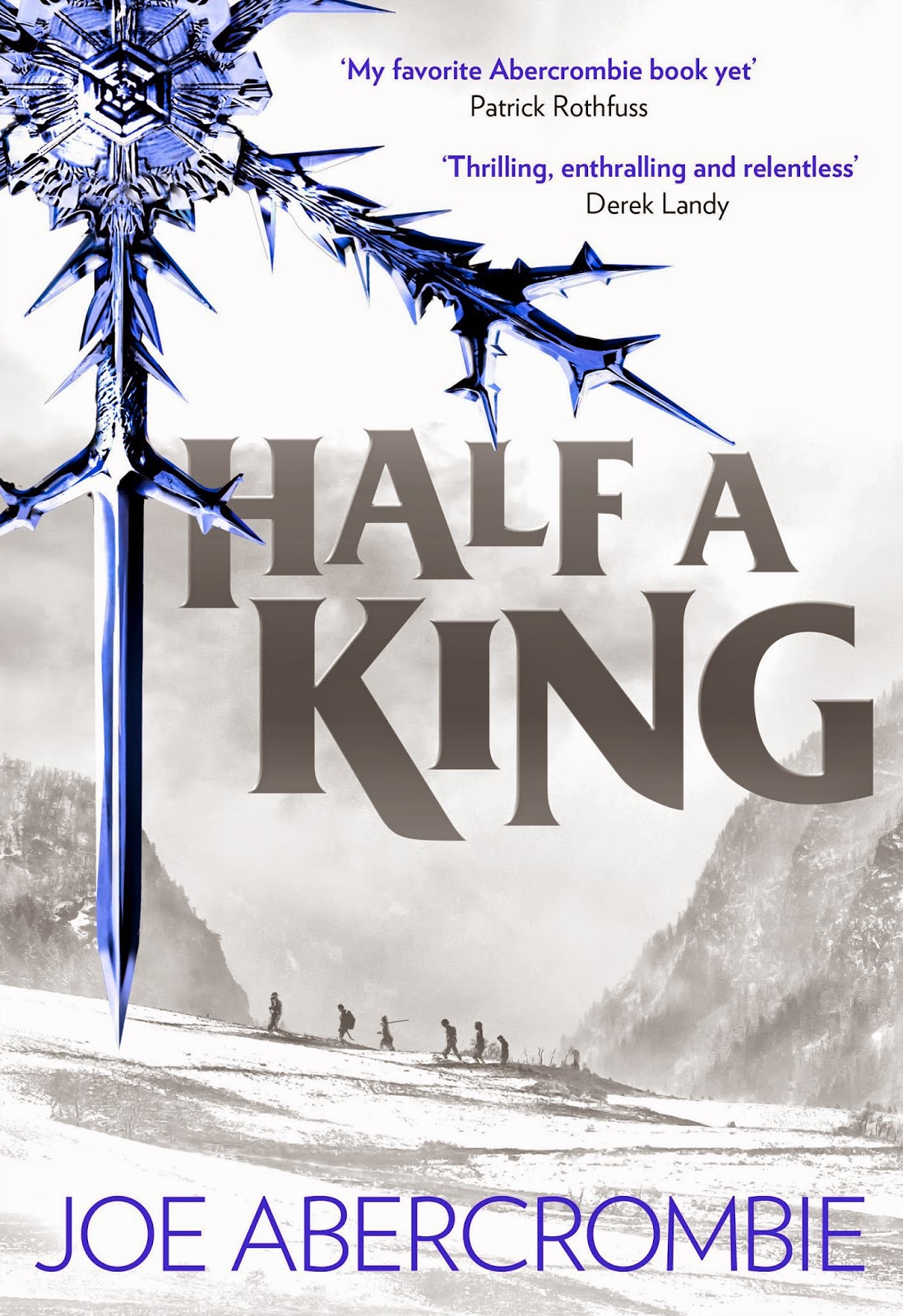
Half A King - Book Review

Ever since I discovered Joe Abercrombie through his First Law trilogy, I've enjoyed every one of his works. Though Half a King wasn't as gripping a plot as as the First Law trilogy (which is technically not a fair point to make, considering one's a standalone book, and the other is a series of three), nor as deviously charming as Best Served Cold (my fave of his), I still devoured Half A King.

I've always enjoyed Abercrombie's gritty realism. Though Half a King is set in the same world as the First Law trilogy, it doesn't include any fantasy (not that the trilogy had that much to begin with). Still, he doesn't need to add any magic in his stories to make them sound vivid and interesting.

Half A King is the tale of Yarvi, the crippled younger son of the king of Gettland. Think of these people as burly, ruthless, war-adoring Viking-like people. Because he's crippled, Yarvi's always felt himself but half a man (hence the title), and is constantly reminded of that fact by everyone around him, his family included. Though he's trained to become a minister (an order reminiscent of that of the druids), the surprising news of both his father's and older brother's deaths forces him to eschew his brother's robes for those of a king's...

...until he himself is betrayed by those closest to him (dun, dun, duuuuun). After that, Yarvi finds himself on a long, arduous journey of learning and growing as he makes his way from the deepest pits of slavery back  to reclaim the Black Throne. On the way, he makes a a few friends and many enemies, and all the while Death's Last Door is never very far away:

And Yarvi realized then that Death does not bow to each person who passes her, does not sweep out her arm respectfully to show the way, speaks no profound words, unlocks no bolts. The key upon her chest is never needed, for the Last Door stands always open. She herds the dead through impatiently, heedless of rank or fame or quality. She has an ever-lengthening queue to get through. A blind procession, inexhaustible.

Definitely recommended to any who like coming-of-age stories set in an Early Middle Ages-inspired era, with lots of action and intrigue. And on that note, I will leave you with one of the character's summary judgement of life, which explains the tone of the book quite well:

"If life has taught me one thing, it's that there are no villains. only people, doing their best."

June 22, 2014

Storm Front - A Novel Of The Dresden Files

I must admit that it took me 4-5 tries before I managed to finish Storm Front (Dresden Files). I bought the book because I'm always curious to see what made one particular book so special that it shot to the bestseller lists (especially if it's in the sff genres), and this one even has its own comic strip and TV show!

This time, I finally managed to finish it. Perhaps because I was in a different frame of mind or perhaps because it had been a while since I'd read a CSI-style fantasy (this book reminds me a lot of Laurell K. Hamilton's Anita Blake, Vampire Hunter series, which I greatly enjoyed before the latter turned into a XXX series).

Anywho, I thought this book was somewhat entertaining (though I already knew in the first couple of chapters whodunit). There wasn't anything surprising, the plot was fairly straightforward, and the magic was using tropes already employed before (should I blame my voracious reading for ruining the latter for me?).

Recommended for those who want a very easy read, and aren't too versed in the fantasy genre just yet.

Excerpt - Our P.I. Dresden decides to make a couple of potions, but first he needs to convince his interactive grimmoire-ish partner to help him out...

   The lights came up and revealed a long table in the center of the room, other tables against three of the walls around it, and a clear space at one end of the room where a brass circle had been laid out on the floor and fastened into the cement with U-shaped bolts. Shelves over the tables were crowded with empty cages, boxes, Tupperware, jars, cans, containers of all descriptions, a pair of unusual antlers, a couple of fur pelts, several musty old books, a long row of notebooks filled with my own cramped writing, and a bleached white human skull.
   "Bob," I said. I started clearing space off of the center of the table, dumping boxes and grocery sacks and plastic tubs over the brass circle on the floor. I needed room to work. "Bob, wake up."
   There was a moment of silence while I started getting some things down from the shelves. "Bob!" I said, louder. "Come on, lazybones."
   A pair of lights came up in the empty sockets of the skull, orangish, flickering like candle flames. "It isn't enough," the skull said, "that I have to wake up. I have to wake up to bad puns. What is it about you that you have to make bad puns?"
   "Quit whining," I told him, cheerfully. "We've got work to do."
   Bob the Skull grumbled something in Old French, I think, though I got lost when he got to the anatomical improbabilities of bullfrogs. He yawned, and his bony teeth rattled when his mouth clicked closed again. Bob wasn't really a human skull. He was a spirit of air--sort of like a faery, but different. He made his residence inside the skull that had been prepared for him several hundred years ago, and it was his job o remember things. For obvious reasons, I can't use a computer to store information and keep track of the slowly changing laws of quasiphysics. That's why I had Bob. He had worked with dozens of wizards over the years, and it had given him a vast repertoire of knowledge--that, and a really cocky attitude. "Blasted wizards," he mumbled.
   "I can't sleep, so we're going to make a couple of potions. Sound good?"
   "Like I have a choice," Bob said. "What's the occasion?"
   I brought Bob up to speed on what had happened that day. He whistled "no easy trick without lips), and said, "Sounds sticky."
   "Pretty sticky," I agreed.
   "Tell you what," he said. "Let me out for a ride, and I'll tell you how to get out of it."
   That made me ware. "Bob, I let you out once. Remember?"
   He nodded dreamily, scraping bone on wood. "The sorority house. I remember."
   I snorted, and started some water to boiling over one of the burners. "You're supposed to be a spirit of intellect. I don't understand why you're obsessed with sex."
   Bob's voice got defensive. "It's an academic interest, Harry."
   "Oh year? Well, maybe I don't think it's fair to let your academia go peeping in other people's houses."
   "Wait a minute. My academia doesn't just peep--"
   I held up a hand. "Save it. I don't want to hear it."
   He grunted. "You're trivializing what getting out for a bit means to me, Harry. You're insulting my
masculinity."
   "Bob," I said, "you're a skull. You don't have any masculinity to insult."
   "Oh yeah?" Bob challenged me. "Pot kettle black, Harry! Have you gotten a date yet? Huh? Most men have something better to do in the middle of the night than play with their chemistry sets."
   "As a matter of fact," I told him, "I'm set up for Saturday night."
   Bob's eyes fluttered from orange to red. "Oooooo." He leered. "Is she pretty?"
   "Dark skin," I said. "Dark hair, dark eyes. Legs to die for. Smart, sexy as hell."
   Bob chortled. "Think she'd like to see the lab?"
   "Get your mind out of the gutter."
   "No, seriously," Bob said. "If she's so great, what's she doing with you? You aren't exactly Sir Gawain, you know."
   It was my turn to get defensive. "She likes me," I said. "Is that such a shock?"
   "Harry," Bob drawled, his eye lights flickering smugly, "what you know about women, I could juggle."
   I stared at Bob for a moment, and realized with a somewhat sinking feeling that the skull was probably right. Not that I would admit that to him, not in a million years, but he was.
   "We're going to make an escape potion," I told him. "I don't want to be here all night, so can we get to work? Huh? I can only remember about half the recipe."
   "There's always room to make two if you're making one, Harry. You know that."
   That much was true. The process of mixing up an alchemical potion is largely stirring, simmering, and waiting. You can always get another one going and alternate between them. Sometimes you can even do three, though that's pushing i. "Okay, so, we'll make a copy."
   "Oh, come on," Bob chided me. "That's dull. You should stretch yourself. Try something new."
   "Like what?"
   Bob's eye sockets twinkled cheerfully. "A love potion, Harry! If you won't let me out, at least let me do that! Spirits know you could use it, and--"
   "No," I said, firmly. "No way. No love potion."
   "Fine," he said. "No love potion, no potion either."
   "Bob," I said, warningly.
   Bob's eye lights winked out.
   I growled. I was tired and cranky, and under the best of circumstances I am not exactly a type A personality. I stalked over, picked up Bob by the jaws and shook him. "Hey!" I shouted. "Bob! You come out of here! Or I'm going to take this skull and throw it down the deepest well I can find! I swear to you, I'll put you somewhere where no one can ever let you out ever again!"
   Bob's eyes winked on for a moment. "No you won't. I'm far to valuable." Then they winked out again.
   I gritted my teeth and tried not to smash the skull to little pieces on the floor. I took deep breaths, summoning years of wizardly training and control to not throw a tantrum and break the nice spirit to little pieces. Instead, I put the skull back on the shelf and counted slowly to thirty.
   Could I make the potion by myself? I probably could. But I had the sinking feeling that it might not have precisely the effect I wanted Potions were a tricky business, ad a lot more relied upon precise details than upon intent, like spells. And just because I made a love potion didn't mean I had to use it. Right? It would only be good for a couple of days, in any case--surely not through the weekend. How much trouble could it cause?

   I struggled to rationalize the action. It would appease Bob, and give him some kind of vicarious thrill. Love potions were about the cheapest things in the world to make, so it wouldn't cost me too much. And, I thought, if Susan should ask me for some kind of demonstration of magic (as she always did), I could always--
   No. That would be too much. That would be like admitting I couldn't get a woman to like me on my own, and it would be unfair, taking advantage of the woman. What I wanted was the escape potion. I might need it at Bianca's place, and I could always use it, if worse came to worst, to make a getaway from Morgan and the White Council. I would feel a lot better if I had the escape potion.
   "Okay, Bob. Fine. You win. We'll do them both. All right?"


February 9, 2014

The Wise Man's Fear


   "So tell me. How does it work?"
   "It?" I asked.
   "Magic," she said. "Real magic."
   Wil, Sim, and I exchanged glances.
   "It's complicated," I said.
   Denna shrugged and leaned back in her chair. "I have all the time in the world," she said. "And I need to know how it works. Show me. Do some magic."
   The three of us shifted uncomfortably in our seats. Denna laughed.
   "We're not supposed to," I said.
   "What?" she asked. "Does it disturb some cosmic balance?"
   "It disturbs the constables," I said. "They don't take kindly to that sort of thing over here."
   "Th masters at the University don't care for it much either," Wil said. "They're very mindful of the University's reputation."
   "Oh come now," Denna said. "I heard a story about how our man Kvothe called up some sort of demon wind." She jerked her thumb at the door behind her. "Right in the courtyard outside."
   Had Ambrose told her that? "It was just a wind," I said. "No demon involved."
   "They whipped him for it, too," Wil said.
   Denna looked at him as if she couldn't tell if he were joking, then shrugged. "Well I wouldn't want to get anyone in trouble," she said with glaring insincerity. "But I am powerfully curious. And I have secrets I am willing to offer in trade."
   Sim perked up at this. "What sort of secrets?"
   "All the vast and varied secrets of womankind," she said with a smile. "I happen to know several things that can help improve your failing relations with the gentler sex."
Young Kvothe
   Sim leaned closer to Wil and asked in a stage whisper, "Did she say failing, or flailing?"
   Wil pointed at his own chest, then Sim's. "Me: failing. You: flailing."
   Denna raised one eyebrow and cocked her head to one side, looking at the three of us expectantly.
   I cleared my throat uncomfortably. "We're discouraged from sharing Arcanum secrets. It's not strictly against the laws of the University--"
   "It is, actually," Simmon interrupted, giving me an apologetic look. "Several laws."
   Denna gave a dramatic sigh, looking up at the high ceiling. "I thought as much," she said. "You lot just talk a good game. Admit it, you can't turn cream into butter."
   "I happen to know for a fact that Sim can turn cream into butter," I said. "He just doesn't like to because he's lazy."
   "I'm not asking you to teach me magic," Denna said. "I just need to know how it works."
   Sim looked at Wil. "That wouldn't fall under Unsanctioned Divulgence would it?"
   "Illicit Revelation," Wil said grimly.
   Denna leaned forward conspiratorially, resting her elbows on the table. "In that case," she said, "I am also willing to finance a night of extravagant drinking, far above and beyond the simple bottle you see before you." She turned her gaze to Wil. "One of the bartenders here has recently discovered a dusty stone bottle in the basement. Not only is it fine old scutten, drink of the kings of Cealdim, it is a Merovani as well."
Kvothe is a brilliant musician
   Wilem's expression didn't change, but his dark eyes glittered.
   I looked around the largely empty room. "Orden is a slow night. We shouldn't have any trouble if we keep things quiet." I looked at the other two.
   Sim was grinning his boyish grin. "It seems reasonable. A secret for a secret."
   "If it is truly a Merovani," Wilem said, "I am willing to risk offending the masters' sensibilities somewhat."
   "Right then," Denna said with a wide grin. "You first."
   Sim leaned forward in his chair. "Sympathy is probably the easiest to get a grip on," he said, then paused as if uncertain how to proceed.
   I stepped in. "You know how a block and tackle lets you life something too heavy for you to lift by hand?"
   Denna nodded.
   "Sympathy lets us do things like that," I said. "But without all the awkward rope and pulleys."
   Wilem dropped a pair of iron drabs onto the table and muttered a binding. He pushed the right-hand one with a finger, and the left-hand one slid across the table at the same time, mimicking the motion.
   Denna's eyes went a little wide at this, and while she didn't gasp, she did draw a long breath through her nose. It only then occurred to me that she'd probably never seen anything like this before. Given my studies, it was easy to forget that someone could live mere miles from the University without ever having any exposure to even the most basic sympathy.
   The her credit, Denna recovered from her surprise without missing a beat. With only the slightest hesitation, she reached out a finger to touch one of the drabs. "This is how the bell in my room worked," she mused.
  I nodded.
Young Kvothe & friends
   Wil slid his drab across the table, and Denna picked it up. "The other drab rose off the table too, bobbing in midair. "It's heavy," she said, then nodded to herself. "Right, because it's like a pulley. I'm lifting both of them."
   "Heat, light, and motion are all just energy," I said. "We can't create energy or make it disappear. But sympathy lets us move it around or change it from one type into another."
   She put the drab back down on the table and the other followed suit. "And this is useful how?"
   Wil grunted with vague amusement. "Is a waterwheel useful?" she asked. "Is a windmill?"
   I reached into the pocket of my cloak. "Have you ever seen a sympathy lamp?" I asked.
   She nodded.
   I slid my hand lamp across the table to her. "They work under the same principle. They take a little bit of heat and turn it into light. It converts one type of energy into another."
Kvothe in the middle of another adventure
   "Like a moneychanger," Wil said.
   Denna turned the lamp over in her hands curiously. "Where does it get the heat?"
   "The metal itself holds heat," I explained. "If you leave it on, you'll eventually feel the metal get chilly. If it gets too cold, it won't work." I pointed. "I made that one, so it's pretty efficient. Just the heat from your hand should be enough to keep it working."
   Denna flicked the switch and dull red light shone out in a narrow arc. "I can see how heat and light are related," she said thoughtfully. "The sun is bright and warm. Same with a candle." She frowned. "But motion doesn't fit into it. A fire can't push something."
   "Think about friction," Sim chimed in. "When you rub something it gets hot." He demonstrated by running his hand across the fabric of his pants. "Like this."
   He continued rubbing his thigh enthusiastically, unaware of the fact that, since it was happening below the level of the table, it looked more than slightly obscene. "It's all just energy. If you keep doing it, you'll feel it get hot."

   Denna somehow kept a straight fce. But Wilem started to laugh, covering his face with one hand, as if embarrassed to be sitting at the same table with Sim.
   Simmon froze and flushed red with embarrassment.
A cute Kvothe and Denna
   I came to his rescue. "It's a good example. The hub of a wagon wheel will be warm to the touch. That heat comes from the motion of the wheel. A sympathist can make the energy go the other way, from heat into
motion." I pointed to the lamp. "Or from heat into light."
   "Fine," she said. "You're energy moneychangers. But how do you make it happen?"
   "There's a special way of thinking called Alar," Wilem said. "You believe something so strongly that it becomes so." He lifted up one drab an the other followed it. "I believe these two drabs are connected, so they are." Suddenly the other drab clattered to the tabletop. "If I stop believing, it stops being so."
   Denna picked up the drab. "So it's like faith?" she said skeptically.
   "More like strength of will," Sim said.
   She cocked her head. "Why don't you call it strength of will, then?"
   "Alar sounds better," Wilem said.
   I nodded. "If we didn't have impressive-sounding names for things, no one would take us seriously."

This is a short passage from Patrick Rothfuss's The Wise Man's Fear: The Kingkiller Chronicle: Day Two, explaining the basics of Sympathy, one of the major arts that the hero learns at the University, to the girl of his dreams.
From Patrick Rothfuss's own website

The Chandrian, Kvothe, and Bast
It had been a while since I'd read the First Day in the Kingkiller Chronicle, The Name of the Wind, so I must admit that at first I had a little trouble getting to recall all the rules of this world, as well as piece together what had happened previously. But once I got past that, I really got suckered into the book.

The Wise Man's Fear is like a Storynception! It picks up right where the first book left off, with the present-
day Kvothe (aka Kote aka Reshi) dictating his youth to the scribe Chronicler. And while telling of his time at the University, followed by his adventures to the "edge of the map" (and even off it, if you count Fae land), he also adds a number of other tales and stories that constitute "The Four Corners of Civilization"'s mythos, including the ones he finds out about "The Chandrian" (the evil people responsible for the gruesome death of his parents).

The Great Patrick Rothfuss
himself


I can't help but wonder if those tales don't hide different keys to what's about to happen in book three (the last of this series, if Rothfuss happens to keep his story as a trilogy--I know other authors who changed their minds midway) and give away the key to Kvothe's whole quest. Then again, I tend to be rather optimistic, and am keeping my fingers crossed that Rothfuss doesn't pull a G.R.R. Martin on us... In any case, I'm very much looking forward to reading Book 3, whenever it comes out!

August 19, 2013

Blood Of The Fey - Morgana Trilogy Book I

In early celebration of Labor Day weekend (since I will be spending the weekend working on my book instead), Blood of the Fey is now $3.99 on Amazon Kindle until the end of the year!

The Kirkus Review for my book's out:

The first of an intended trilogy inspired by Arthurian legend, this ambitious, imaginative debut novel intertwines fallen angels, dark magic, modern-day threats and teenage angst.
After the suspicious death of a classmate, teenage loner Morgan Pendragon is sent away in disgrace from the Swiss Catholic boarding school where she has spent most of her life. She’s sent to the home in Wisconsin she has never seen, to parents—a mother and stepfather—who never visited. The only friendly face belongs to the family’s elegant, mute lawyer, who’s drawn with enigmatic finesse. The unhappy teen learns that she’s to attend school with Arthur, the half brother she recently met for the first time. The school, it turns out, is located in a secret land directly beneath Lake Winnebago. It houses a training ground for modern-day Knights of the Round Table, aka KORT, young warriors-to-be who battle against Earth-dwelling fallen angels—the Fey—who have long been at war with humankind. The KORT students learn weaponry, combat and the ability to call upon elemental magic, while a Catholic priest oversees their spiritual needs. (Religious faith is an intriguing if sketchy element here; how it develops over the next two novels in the trilogy remains to be seen.) Bullied by students suspicious of her ignorance of the world they’ve known since birth, Morgan begins to question their zealous desire for all-out destruction of the Fey, even as she puzzles out the possibility that the world might be weakening against the worst of the magical evils. While Morgan struggles to find a place in her new world and wonders about the mystery of the father she never knew, she begins to realize that not everyone is what they seem—herself included. Ellefson keeps readers guessing and juggles imaginative twists, placing her heroine under an increasing threat that escalates to a suspenseful ending guaranteed to leave readers hungry for the next installment.
A creative, well-crafted narrative filled with colorful characters, a conflicted heroine and a multifaceted plot.

June 12, 2013

The Golem And The Jinni

The Encounter:

And then, down one of the streets, a strange light appeared, seeming to float in midair.  She paused, alarmed.  The light was coming her way.  It grew closer, and she saw that it was not a light, but a face, and the face belonged to a man.  He was tall, taller than she, and bareheaded.  His dark hair was cropped close to his skull.  His face--and his hands as well, she saw now--shone with that warm light, like a lamp shaded with gauze.
     She watched him come nearer, unable to take her eyes away.  She saw him glance at her, and then look again.  Then he too stopped.  At that distance, she could not feel his curiosity, but his expression made it plain.  What, he was thinking, is she?
     The shock of it rooted her to the spot.  Only the Rabbi had ever been able to see her as something different.
     She knew she should turn and run.  Get away from this man, who by seeing her, truly seeing her, already knew too much.   But she couldn't.  The rest of the world had fallen away.  She had to know who he was.  What he was.
     And so, as the man started his cautions approach, the Golem stood her ground, and waited.

 The Golem and the Jinni is about two non-human entities trying to make a life for themselves amongst humans.  Beautifully written, it takes you down the streets of New York at the dawn of the 20th century and down the Bedouin desert roads a millennium before, showing how these two individuals' fates are interwoven and their struggles to become free from their destinies.

A definite recommend!

May 13, 2013

Miss Peregrine’s Home for Peculiar Children


I was happily surprised by this book.  I must admit that, as with most books, I'd purchased this one because of its intriguing cover.  But once I started reading it, I was sucked in.  I at first thought this was a ghost story, which literally gave me goosebumps while I was reading.  But it turned out to be a different twist.

But what makes this story unique are all the different, and odd pictures strewn about the story. I believe the author found those pictures and then created a story around it.  And a fun one at that!

“The composition of the human species is infinitely more diverse than most humans suspect,” she began. “The real taxonomy of Homo sapiens is a secret known to only a few, of whom you will now be one. At base, it is a simple dichotomy: there are the coerlfolc, the teeming mass of common people who make up humanity’s great bulk, and there is the hidden branch—the crypto-sapiens, if you will—who are called syndrigast, or “peculiar spirit” in the venerable language of my ancestors. As you have no doubt surmised, we here are of the latter type.”

It's very obvious that this is only the first in a series of books, but I look forward to reading more from this author.

Miss Peregrine's Home for Peculiar Children