Showing posts with label Knights. Show all posts

June 17, 2013

La Belle Dame Sans Merci


Here is a nice poem by John Keats regarding knights and faeries, a perfect accompaniment (and one much better expressed) to Blood of the Fey.

O WHAT can ail thee, knight-at-arms,
Alone and palely loitering?
The sedge has wither'd from the lake,
And no birds sing.

O what can ail thee, knight-at-arms!
So haggard and so woe-begone?
The squirrel's granary is full,
And the harvest's done.

I see a lily on they brow
With anguish moist and fever dew,
And on thy cheeks a fading rose
Fast withereth too.


I met a lady in the meads,
Full beautiful--a faery's child,
Her hair was long, her foot was light,
And her eyes were wild.

I made a garland for her head,
And bracelets too, and fragrant zone;
She look'd at me as she did love,
And made sweet moan.

I set her on my pacing steed,
And nothing else saw all day long,
For sidelong would she bend, and sing
A faery's song.

She found me roots of relish sweet,
And honey wild, and manna dew,
And sure in language strange she said--
"I love thee true."

She took me to her elfin grot,
And there she wept, and sigh'd fill sore,
And there I shut her wild wild eyes
With kisses four.

And there she lulled me asleep,
And there I dream'd--Ah! woe betide!
The latest dream I ever dream'd
On the cold hill's side.

I saw pale kings and princes too,
Pale warriors, death-pale were they all;
They cried--"La Belle Dame sans Merci
Hath thee in thrall!"

I saw their starved lips in the gloam,
With horrid warning gaped wide,
And I awoke and found me here,
On the cold hill's side.


And this is why I sojourn here,
Alone and palely loitering,
Though the sedge is wither'd from the lake,
And no birds sing.


April 23, 2013

The Nine Worthies


In the Late Middle Ages, at a time when the crusades were over and Europe was ravaged by pestilence and the Black Death, eyes turned their eyes to the valiant princes of the past for direction.

The Nine Worthies were therefore considered to be:

I. The Good Pagans:
a) Hector – The greatest fighter in the Trojan War. He was courageous and “peace-loving, thoughtful and bold, and a good son, husband and father.”  A truly noble figure.  He died at the hands of Achilles.
b) Alexander the Great – a prince of Macedonia in ancient times who was tutored by Aristotle then became the ruler of one of the largest empires of the time, spanning from Greece to India.  Known for having cut the Gordian Knot.
c) Julius Caesar – the first Roman Emperor (or more like “dictator in perpetuity”) who defeated Gaul and expanded the power of Rome to Germany and Great Britain. He was assassinated by Marcus Junius Brutus at the tender age of fifty-five.

II. The Good Jews:
a) Joshua – Became the leader of the Israelites after Moses’s death, for whom he spied in Canaan.  Once Moses dead, he lead his people to the conquest of that land which he later apportioned into tribes.
b) David – Second King of Israel and an ancestor of Jesus according to the Christian Bible, considered to be a (mostly) righteous king, a warrior, poet and musician, among other things.
c) Judas Maccabeus – One of the greatest warriors in Jewish history.  The son of a priest, he and his brothers started a revolt against the Seleucid ruler who had forbidden to practice the Jewish religion, using guerrilla warfare to defeat the superior Seleucid army.  His death inspired the Jews to not give up and, after a few more years of battle, they were able to achieve their independence.

III. The Good Christians:
a) King Arthur – According to legend, Arthur defended the Britons against the invading Saxons.  Myths depict him as having been guided early on by a wily Merlin, and leading his people to victory in many battles with the help of the Knights of the Round Table and his trustworthy sword Excalibur (gifted to him by the Lady of the Lake).  At his death, his body was buried in the mysterious Isle of Avalon.
b) Charlemagne – King of the Franks and later first Emperor of the Holy Roman Empire after the collapse of Rome.   He defended Christianity and spread its teachings with victorious battles throughout Europe.  He also encouraged art, religion and culture (he is known notably for creating schools).
c) Godfroi de Bouillon – A Medieval Frankish knight who lead the First Crusade into capturing Jerusalem and became its first Christin ruler (he apparently refused to be called a King).

Anyone who aspired to be a truly chivalrous person needed to study and emulate their lives.

Sources:

The World of King Arthur
Wikipedia (Hector, Alexander the Great,  Julius Caesar, Joshua, David, Judas Maccabeus, King Arthur, Charlemagne, Godfroi de Bouillon)

August 4, 2012

Back In The Olden Dayes...


In the olde dayes of Kyng Arthour,
Of which the Britons speken greet honour,
Al was this land fulfild of fairye.
The elf-queene with her joly compaignye
Daunced ful ofte in many a grene mede.
This was the olde opinion as I rede...
Geoffrey Chaucer, The Canterbury Tales


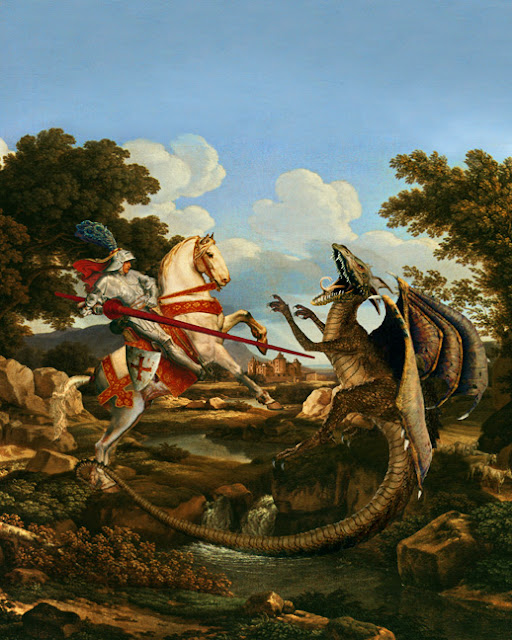
Have you ever wondered whether olden tales were actually based on truth?  That the fey walked the earth like we now do, except for their hidden (and sometimes not-so-hidden) talents… that dragons really did fly overhead and that, but for the courage and devotion of valiant knights giving up their lives for our rescue, humans may no longer be around?

But where are they now, the fey and the dragons, the small folk and other spirits of yore?  What happened to them?  Have they ever even existed?  And if they have, did they truly disappear, or are they now lurking in some dark corners of the earth, biding their time for the right moment to strike back at us?

PS: all the great art has been painted by Howard David Johnson

April 7, 2012

A Knight's Oath

    It's interesting to see how one was expected to live back in the Middle Ages if one was to be a knight.  Sure, they had to be good Christians, be loyal to their King and accomplish lots of great deeds... but the most important goal was to gain one woman's love only.


“To reverence King, as if he were
Their conscience, and their conscience as their King,
To break the heathen and upholding the Christ
To ride abroad redressing human wrongs,
To speak no slander, no, nor listen to it,
To honour his own word as if his God’s,
To lead sweet lives in purest chastity,
To love one maiden only, cleave to her,
And worship her by years of noble deeds,
Until they won her.”
~Le Morte D'Arthur, Sir Thomas Malory